
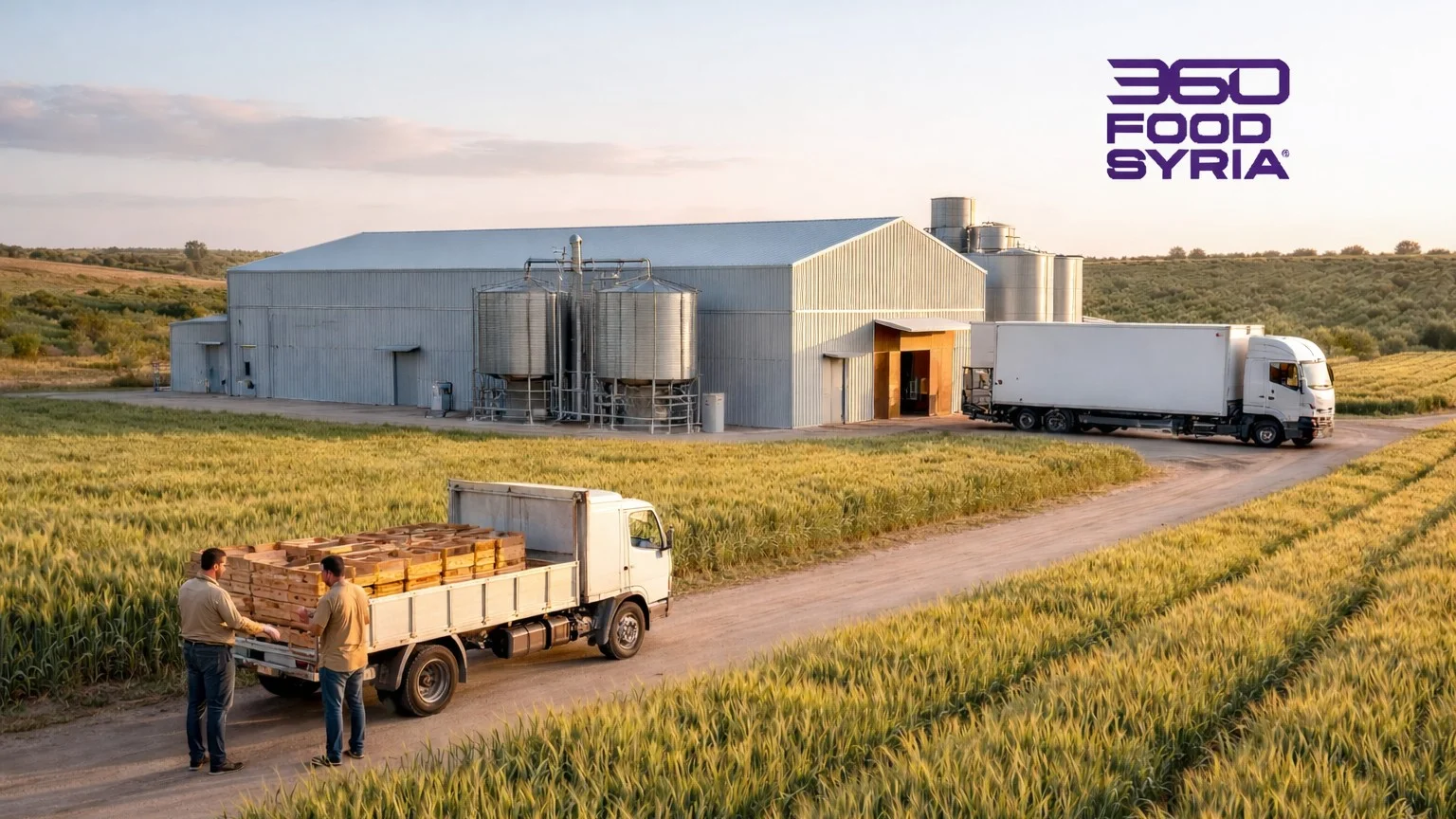
Funding pressures are intensifying, global priorities are shifting, and the model of emergency-only food distribution isn't enough. For Syria, the path forward runs through stronger local value chains, practical partnerships between NGOs and the private sector, and a fundamental rethinking of what it means to feed a nation. The conversation convenes in Damascus this October at 360Food Syria.
Syria's food story over the past decade has been written in the language of emergency; aid trucks, warehouses, distribution queues and ration cards.
Today more than 9.1 million people in Syria are food insecure. Both maternal malnutrition and acute malnutrition in children under five are at global emergency thresholds. Syria faces multiple crises, with 16.5 million people needing humanitarian assistance in 2025.
The emergency model, for all its necessity, no longer operates in a vacuum but under siege from a different kind of pressure: global funding constraints. This is why 2026 is a turning point; Not because the emergency is over, but because the systems that have sustained millions of people are themselves becoming unsustainable at their current scale.
Syria's food economy must evolve to adapt to the financial terrain it now inhabits. While acute hunger rises, financing falls drastically short. This has reduced aid coverage, food rations and acute malnutrition treatment even for the most vulnerable. For Syria specifically, the numbers paint a picture of a system running on fumes. WFP has warned that failure to secure funding could force it to reduce emergency food assistance, and suspend nutrition programmes supporting more than 100,000 women and children.
Why Food Sovereignty Matters for Syria
Two terms dominate the conversation about how nations feed their people, and their distinction is structural.
1. Food security: Do people have consistent access to sufficient, nutritious food?
2. Food sovereignty: Does a community, a region, or a nation have the capacity to control its own food systems? Can it produce, process, distribute, and regulate its food in ways that reflect its own economic needs, cultural preferences, and long-term resilience?
For Syria, this distinction has never been more relevant, the nation once had the second most productive agricultural sector in the Middle East after Turkey. Agriculture counted for almost one-quarter of GDP, employing 17 per cent of the working population. Before 2011, Syria produced approximately 4 million tonnes of wheat annually, enough to meet local consumption and allow for exports to neighbouring countries.
That capacity has been devastated. In the 2024-2025 season, estimated production stood at only 922,000 tonnes compared with 2.4 million tonnes in 2023-2024. The Syrian General Grain Establishment announced in September 2025 that the country needs 2.5 million tonnes of wheat annually to guarantee food security and maintain strategic reserves. Production covers a fraction of that demand, this gap is filled by imports and aid. This is not sovereignty. It is dependence, and in an era of shrinking aid budgets and volatile global supply chains, dependence is a strategic vulnerability.
The statistics alone do not capture the scale of what has been lost. Fourteen years of crisis have devastated Syria's agricultural systems: irrigation networks lie damaged or destroyed, farmers face severe shortages of inputs, technical support, and market access, all exacerbated by desertification and climate shocks. An estimated 1.5 million olive trees were lost across Northwest Syria since 2011. Livestock herders report their herds are on average less than a third of their pre-conflict size. Climate change has also intensified droughts and floods.
Yet amid this devastation, there are signs that recovery is not only possible but already taking root. The need is enormous. So is the potential.
Beyond Emergency Aid: What Food Sovereignty Looks Like
Humanitarian assistance remains a critical lifeline for millions across Syria, but deepening funding shortfalls have forced agencies to scale back support. Food assistance deliveries in 2025 dropped below levels recorded in 2024 due to funding gaps and operational constraints which include infrastructure damage, electricity outages, and fuel shortages that reduce distribution capacity countrywide.
Meanwhile, the import model carries its own fragilities. When food must be shipped from abroad, priced in foreign currency, and distributed through centralised logistics networks, every link in the chain becomes a potential point of failure. Currency depreciation erodes purchasing power. Cold chain infrastructure is fractured. The answer is not to abandon the emergency model, but build alongside it.
Food sovereignty, in Syria’s context, means restoring production so that a greater share of national demand can be met domestically, rebuilding irrigation infrastructure so that farming is not entirely dependent on increasingly erratic rainfall, developing food processing capacity so that raw agricultural output can be transformed into shelf-stable, nutritious products closer to where people live, and investing in cold chain and logistics infrastructure so that perishable goods do not spoil before they reach markets or distribution points.
And critically, it means connecting the demand signals already present in the humanitarian system with the supply capacity that exists within Syria itself.
The Missing Middle: Bridging Humanitarian Demand and Domestic Supply
Humanitarian organisations operate under rigorous accountability frameworks. Procurement standards for food quality, documentation, traceability, and compliance are stringent for good reason. They protect beneficiaries, ensure donor confidence and maintain programme integrity.
Local producers and manufacturers, operating under the immense economic pressures of a post-conflict environment, often struggle to meet these standards quickly. Many have the capacity to produce food at scale. What they lack is the documentation, the quality assurance infrastructure, or the familiarity with international procurement processes that would allow them to supply humanitarian operations.
This has created what might be called a missing middle. On one hand, there is substantial humanitarian demand for food products, on the other, there is domestic supply capacity that cannot access that demand because the bridge between the two has not been built. WFP already sources more than 60 per cent of food in locations where it operates. The principle of local and regional procurement is well established at the global level. The challenge in Syria is translating that principle into practice at the speed and scale required.
Closing this gap requires direct, practical engagement: suppliers meeting procurement officers, quality expectations being discussed face to face, documentation requirements being clarified, and realistic timelines being established for compliance.
A Political Transition and Its Implications for the Food Economy
Following the shift in Syria's political landscape, more than 210,000 Syrian refugees returned to their homeland. These returning populations need an economy that can absorb them, not merely an aid system that can register them.
The government has signalled its intent to rebuild. The easing of sanctions, renewed international engagement, and direct requests from the authorities for institutional support offer entry points for short, medium and longer-term recovery.
Yet this transition is unfolding within a global food system at a crossroads. Conflict, economic shocks and weather extremes are driving hunger to unprecedented levels. Within this global landscape, the struggle over food sovereignty is shifting from farms to trade regimes, where market access is becoming the primary instrument of power. Countries that can produce, process, and trade food on their own terms are more resilient. Those that cannot are at the mercy of volatile commodity markets, unreliable shipping routes, and the political priorities of distant donors.
For Syria, in a world where humanitarian funding is declining, climate shocks are intensifying, and geopolitical tensions are reshaping supply chains, the ability to produce food locally is not a luxury. It is a strategic necessity.
Why Local Value Chains Are the Foundation of Resilience
The case for stronger local food value chains is both moral and economic. When procurement can responsibly include local and national suppliers, the benefits cascade through the economy. Farmers who can sell crops at fair prices reinvest in their land. Processors who can access consistent demand invest in equipment and hire workers. Logistics providers who move goods within the country build capacity that serves both commercial and humanitarian clients. Employment generated in food production, processing, and distribution creates household income that reduces dependency on aid.
This is not charity repackaged as commerce. It is the recognition that functioning markets are part of a functioning food system, and that resilience ultimately depends on linkages between demand and supply. WFP itself is working to promote self-sufficient communities and reduce their reliance on urgent assistance, helping families across Syria to restore their livelihoods. Through vocational training and the rehabilitation of local infrastructure such as irrigation channels and bakeries, Syrian families have opportunities to remain on their farms, grow their own food and improve their incomes.
Syrian exports grew by 39 per cent in the first half of 2025, reaching EUR 500 million and covering over 90 countries. Growth was led by industrial and agricultural products. The productive base is damaged, but with the right investment and the right connections, it can be rebuilt.
Food Technology and Infrastructure: The Enablers of Sovereignty
Food sovereignty is not only about what grows in the field. It is about what happens after harvest. In Syria, post-harvest losses are significant. Storage infrastructure has been degraded by years of conflict. Cold chain systems are fragmented by electricity shortages and fuel scarcity. Packaging capacity is limited. Traceability systems, essential for both food safety and compliance with international procurement standards, are largely absent.
Food technology interventions that improve shelf life, reduce spoilage, enhance food safety, and strengthen traceability can materially improve outcomes across the entire food system. They are the connective tissue between production and consumption. Without them, even increased agricultural output will not translate into improved food security. The WFP is supporting early recovery and resilience projects, including rehabilitation of water pumping stations, bakeries, and grain silos, as well as irrigation infrastructure.
These investments are critical, but they represent only a fraction of what is needed. Scaling the infrastructure requires capital, expertise, and partnerships that the public sector alone cannot provide.
The Role of Structured Engagement: Why Platforms Matter
Humanitarian procurement teams need to understand what local suppliers can deliver and on what terms. Local producers need clarity on what compliance with international standards actually requires. Investors need visibility into the opportunities and risks that define the food sector. Donors need confidence that their resources are being directed toward approaches that deliver both immediate relief and long-term resilience.
These connections require structured spaces where stakeholders can engage directly, where capabilities can be assessed in person, and where relationships of trust can begin to form.
This is, in essence, what the exhibition and conference model is designed to provide: a verification-ready environment where policy objectives become concrete, actionable conversations.
360Food Syria 2026: A Platform Built for Practical Connection
From 1 to 3 October 2026, the Syrian Expo Center will host 360Food Syria 2026. As Syria's premier international food exhibition, the event is designed to serve a function that goes well beyond display and promotion. 360Food Syria brings together the full spectrum of food economy stakeholders under one roof. NGOs, donors, private sector suppliers, investors, food technologists, cold chain specialists, logistics providers, and agribusiness operators will converge for three days of structured engagement.
The programme is built around several core pillars.
1. A Verification-Ready Environment for Procurement
For humanitarian procurement teams, direct engagement with suppliers is essential. The exhibition format allows stakeholders to meet producers face to face, review production capabilities, discuss quality & documentation expectations, and explore how procurement requirements can be aligned with real supply conditions on the ground.
2. Resilience Through Food Technology and Infrastructure
Exhibitors and partners operating in food technology, packaging, cold chain, and traceability will showcase solutions that can materially improve shelf life, food safety, and delivery performance in Syria's complex operating environment. For a country where infrastructure has been degraded, these technologies are foundational.
3. Structured Dialogue Through the Donor and NGO Roundtable
The Donor and NGO Roundtable is designed to bring together senior decision-makers from humanitarian organisations, donor agencies, and the private sector. The agenda focuses on how localisation objectives, compliance requirements, and resilience goals can be connected in workable, realistic ways. This includes discussion of how suppliers can progress toward international standards, and how procurement processes can better account for on-the-ground conditions without compromising accountability.
4. Conference Streams on Strategy, Standards, and Investment
Beyond the exhibition floor, 360Food Syria features conference streams focused on food security strategy, agricultural recovery, public-private dialogue, investment pathways, and sustainability. These sessions are designed to produce actionable insight, not just conversation.
The Sectors That Will Shape Syria's Food Future
The scope of 360Food Syria reflects the breadth of the challenge.
The event covers:
- Food and Beverages across the full spectrum from staple commodities to value-added products
- Food Technology including processing, preservation, and quality assurance solutions
- HORECA recognising that hospitality and food service sectors are vital to urban economic recovery
- Cold Chain and Logistics addressing one of the most critical infrastructure gaps in Syria's food system
- Agriculture and Ingredients connecting primary producers with processors, buyers, and technical support
- Sustainability and Innovation exploring how climate-resilient and resource-efficient approaches can be embedded in Syria's food systems
- Franchise and Licensing opening pathways for proven food business models to enter the Syrian market
- Private Label enabling domestic producers to access higher-value market segments through partnerships with established brands
A Call for a Different Kind of Conversation
The transition from food security to food sovereignty is not a single leap. It is a series of steps: a supplier meeting an NGO procurement officer and understanding what documentation is required; a cold chain provider deploying a solar-powered unit at a rural storage facility; a food technologist demonstrating a preservation method that adds three months of shelf life to a locally produced staple; a donor agreeing to adjust procurement timelines to accommodate a credible local supplier still building capacity. Together, these steps add up to a systemic shift.
Join the Conversation in Damascus
360Food Syria 2026 is designed to be the space where these steps come into fruition. Where policy meets procurement. Where the future of Syria's food economy begins to take shape through real relationships, credible standards, and genuine market connections.
Dates & Venue: 1 to 3 October 2026 at the Syrian Expo Center - Damascus Fair Grounds, Syria
Focus Areas: Food Security, Agribusiness, Food Technology, HORECA, Cold Chain, Packaging, Sustainability, and Industry Partnerships
Let’s move the conversation forward from short-term relief to long-term resilience through practical partnerships, credible standards, and real market connections. Explore Why Visit, review the Event Features, see how to Exhibit, or Plan Your Trip to join the right conversations in Damascus this October.